



[Rating: Solid Rock Fist Up]
In Theaters Wednesday, November 25
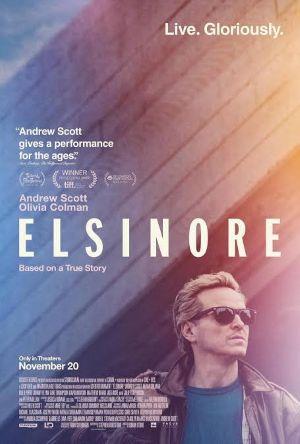
What is it about Shakespeare’s ‘Hamlet’ that allows for such dramatic pliability, either through retelling or reinterpretation? Academics, philosophers, religious scholars, and even Freud have all weighed in on the text to lend some perspective about the tragedy’s enduring place in western culture, yet the world of 2026 doesn’t seem any closer to solving that riddle. Indeed, until it does, movies like Elsinore will endure right alongside ‘Hamlet’ as a testament to the depth of meaning and purpose stitched into every line of the Bard’s text.
Elsinore begins in 1989 during a Royal National Theater production of ‘Hamlet’ led by Daniel Day-Lewis (Tod Tewson), who flees the stage in the middle of a performance and refuses to return. Scottish actor Ian Charleson (Andrew Scott) is making a living in London picking up spare movie and television roles following a string of successful blockbuster appearances earlier in the decade, particularly Chariots of Fire, yet his recent progression from an HIV diagnosis to a full-blown AIDS one occupies most of his thoughts and energy. When director Richard Eyre (Johnny Flynn) reaches out to Ian to ask if he’d like to step into the recently abandoned ‘Hamlet’ role, Ian is quick to accept, but with a full disclaimer about his diagnosis and deteriorating condition.
Ian enters the care of a physician specializing in HIV and AIDS treatment, Dr. Margaret Johnson (Olivia Colman), whose mix of traditional medicine and holistic treatments emphasize rest, nutrition, and the elimination of stress. Ian’s work at the National Theater in perhaps the world’s most demanding dramatic role is very much at odds with this approach, however, yet the actor presses on. “I’d rather die of Hamlet than AIDS,” Ian remarks at one point, and as the company progresses through rehearsals and approaches opening night, this proposition is put to the test.

And while the central conflict of Elsinore revolves around Ian’s assumption of the role of Hamlet in the midst of his physical decline, it is just one component of the story’s dramatic arc, which has a little to do with theater, and everything to do with a man struggling with his own mortality. The delicious narrative symmetry of Hamlet the character grappling with the very same thing pays off with some devastatingly effective crosscuts late in the picture, yet this element is more than just a script gimmick. The engine of Elsinore has more in common with movies like And the Band Played On or The Normal Heart than Hamnet or Branagh’s 1996 adaptation, and director Simon Stone wisely keeps the attention focused on the world where his story resides.
1989 was a terrifying time for victims of HIV and AIDS, whose treatments were limited to little more than palliative care and prognoses that offered outlooks in intervals of months instead of years. Ian’s insistence on playing Hamlet isn’t about accomplishing an artistic goal or capturing one final moment in the spotlight, but a reclamation of a life slipping out of his control. He doesn’t want to just wait around to die: he wants his final days to amount for something at a time when so many of his peers are just fading away into the social ether.
Andrew Scott played Hamlet over one hundred times on stage in 2017, and his complete understanding of the text in concert with his total surrender to the portrayal of Ian’s heroic final days is nothing less than breathtaking. The way Scott carries himself through the back half of the picture, as Ian’s body gives way to the crippling effects of his illness, is a masterclass in on-screen physicality. Scott doesn’t play the sickness, however, but rather the struggle against its symptoms in conjunction with an overwhelming existential panic that never strikes a false note.
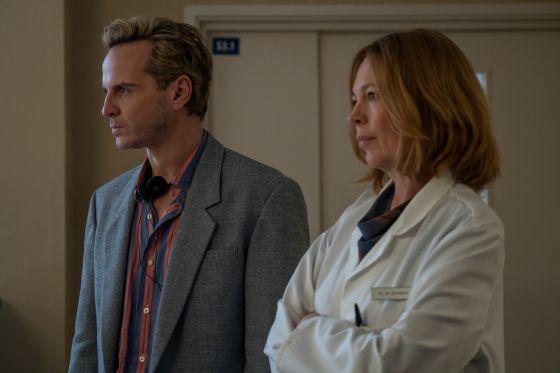
The abundance of hand-held shots keeps the audience close and wrapped up in Ian’s world, layering the story with colors of urgency and intimacy that leap off the screen. The wardrobe and make-up departments also lend credibility to the film not just through the period-appropriate clothing and hairstyles, but by way of the progression of Ian’s illness as it takes its toll on the man. By the time Elsinore gets to the rehearsal stage and Scott performs soliloquies about grief and death by way of a man fading into the last glimmering twilight of life, it’s easy to forget that this is just a dramatic recreation, and not a fly-on-the-wall observation of a miracle of tragic circumstance.
Indeed, Scott and the material are coasting downhill by the end of Elsinore, and don’t need the gas that Stone and the script inject into the third act. If there’s one minor drawback to the effort, it’s that things feel a touch heavy-handed in its waning moments, going for an emotional kill-shot that just isn’t needed. The film up to this point has done a wonderful job establishing the stakes and character dynamics of everyone involved, and while these final heartstring plucks don’t hurt, they feel somewhat excessive.
But as a moving examination of grief, fear, mortality, and legacy with the added benefit of Shakespearean thematic duality, Elsinore knocks it out of the park. Andrew Scott is as good as he’s ever been in a movie, here, and is buttressed by a supporting cast and a real-life story that’s just as compelling as he is. And while Prince Hamlet wrestled with the question of whether to be or not, this take on the tragedy need not search for any justification for its existence.

“Obvious Child” is the debut novel of Warren Cantrell, a film and music critic based out of Seattle, Washington. Mr. Cantrell has covered the Sundance and Seattle International Film Festivals, and provides regular dispatches for Scene-Stealers and The Playlist. Warren holds a B.A. and M.A. in History, and his hobbies include bourbon drinking, novel writing, and full-contact kickboxing.

You must log in to post a comment.