


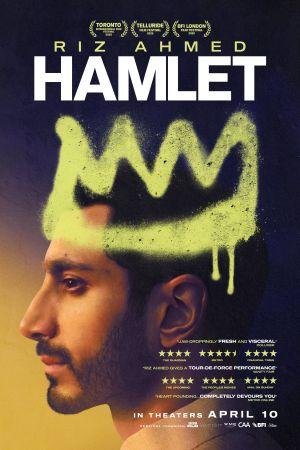

[Rating: Minor Rock Fist Down]
In Theaters Friday, April 10
A dizzying reinterpretation of Shakespeare’s seminal work, director Aneil Karia’s version of Hamlet is bold, to be sure: though any further plaudits are difficult to conjure. A sort of Reader’s Digest version of the Danish prince’s tragedy, this telling carves out a new path for itself while retaining the language of the original, mixing fidelity to the text with a cavalier disregard for the play’s structure, characters, and thematics. Spoiler alert: pretty much everyone still dies, yet the path taken to this conclusion has never felt as bewildering as what is offered up here.
The movie opens in modern day London with Hamlet (Riz Ahmed) preparing his father’s body for funeral rites, and transitions from there to the deceased CEO’s wake, where Hamlet learns that his mother, Gertrude (Sheeba Chaddha), and paternal uncle, Claudius (Art Malik), will soon be wed. Hamlet finds some solace in the company of friends Ophelia (Morfydd Clark) and her brother, Laertes (Joe Alwyn), yet is also spooked by their loyalty to Polonius (Timothy Spall), their shady father. The timing of his mother and uncle’s engagement so soon after his father’s death, not to mention Polonius’ sudden interest in him, has Hamlet on edge, and he finds himself further riled by the appearance of his dead father’s ghost (Avijit Dutt).
The ghost tells Hamlet that Claudius engineered his murder, and that revenge is necessary to right the wrongs of this foul deed. In the first of many departures from the original text, the ghost appears to Hamlet only, forcing the young man to grapple with the possibility that this new supernatural development is all in his head. As he wrestles with the grief of his father’s passing, his mother and uncles’ betrayal, the paranoia born out of Polonius’ scheming, and his own potential madness, Hamlet begins to find purpose and meaning where neither existed before.
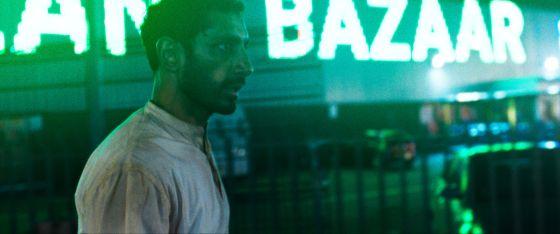
Just what this purpose is or why the audience should care is hard to say. By isolating the ghost’s appearance to just Hamlet, this version of the story changes the very nature of the drama by making it less of an intricate, spite-fueled conspiracy and instead just one young man’s descent into murderous madness. The script by Michael Lesslie also collapses several characters into just a handful, giving much of Horatio’s narrative dynamics to Ophelia (though Hamlet speaks several of Horatio’s lines to her at one point), and folding all of Laertes, Rosencrantz, and Guildenstern into just Laertes.
It’s all just…weird. This Hamlet version wants to have things both ways, using the original play as a compass rather than a foundational text while also drawing lines straight from the Quartos. The problem is that it does neither very well, using the dialogue in fractured order and sometimes from the mouths of different characters: none of whom seem to understand the story they are in or the characters they inhabit. It would be like if someone remade Star Wars and collapsed Han Solo, C3PO, and R2D2 all into one character (who meets Luke in the first 5 minutes).
This isn’t just one person being precious with the material, either, as there have been plenty of respectable “Hamlet” adaptations that have reimagined the setting, cut sections, and even slimmed down the character roster to make this famously long story more manageable. That’s not what’s going on here, though. This version is content to use the baseline narrative of a son grappling with the murder of his father and betrayal of his mother as a jumping-off point to just rattle through the play’s most famous soundbites (some of them very much out of order).
For example, the “to be or not to be” soliloquy comes after the “get thee to a nunnery” interaction here, which if we’re going back to Star Wars, would be like having Luke join up with Obi Wan (who has been merged with Princess Leia into a single character) before the droids make their appearance. It’s just a mess, and doesn’t serve the story or these characters in any meaningful way that would justify the changes for any reason other than simple expediency. And while Ahmed and the cast sink their teeth into the material and do their best to sell the audience on the urgency of all this scheming, the heartbeat of the story is just too inconsistent and patchy.
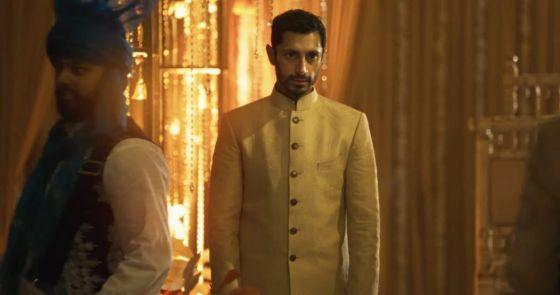
The visual presentation is interesting, and uses a number of dark set-ups and tight light beams to heighten the sense of Hamlet’s desperation and disorientation. The scene where Hamlet puts on a play for Claudius and Gertrude to tease at the circumstances behind his father’s passing is especially colorful and striking, and hints at the ways a transplanted Indian cultural interpretation of the material might have succeeded, yet it’s far too fleeting. How different Indian, Pakistani, or other Asian cultural norms and traditions impact the basic components of this tragedy never develop into anything substantial, and for a Shakespeare adaptation in search of a unique identity, this particular miss feels like a big one.
What, then, of this retelling? As Ahmed says at one point early on: “weary, stale, flat, and unprofitable.”

“Obvious Child” is the debut novel of Warren Cantrell, a film and music critic based out of Seattle, Washington. Mr. Cantrell has covered the Sundance and Seattle International Film Festivals, and provides regular dispatches for Scene-Stealers and The Playlist. Warren holds a B.A. and M.A. in History, and his hobbies include bourbon drinking, novel writing, and full-contact kickboxing.

Comments on this entry are closed.