




[Rating: Rock Fist Way Up]
In Theaters Friday, October 23
It would be easy to write Wicker off as just a horny movie about a middle-aged woman turning to furniture for a good shag, but there’s a universe of stories in this remarkable 105-minute miracle of a movie, and each of them is worth exploring. Using a small medieval village and its denizens as a canvas, directors Alex Huston Fischer and Eleanor Wilson paint a picture that reveals a timeless truth about the human condition: beauty marks, warts, and all. More funny than sad, and with just a pinch more optimism than pessimism, the film remains true to itself and its message from the first frame to its last, leaving nothing on the table and no strand unwoven.
There are no Christian names in Wicker, just titles for the residents of the small hamlet that Fisherwoman (Olivia Colman) strolls into one morning with her catch. Her conversations with Baker (Ben Ashenden), Tailor’s Wife (Elizabeth Debicki), Basket Maker (Peter Dinklage), and others indicate a lifetime of familiarity and kinship, yet this doesn’t shield her from the verbal barbs of her neighbors, who sneer at her unkempt dress and spinster lifestyle. In an act of defiant jest, Fisherwoman commissions Basket Maker to weave her a husband, and one month later she is shocked to discover that he’s done just that.
The Wicker Husband (Alexander Skarsgård) is more than just a prop that Fisherwoman can haul out to mock the Puritanical patriarchy of her community, he’s a sentient, thoughtful, and affectionate spouse that doesn’t just love his wife, but “sees” her. This stands in stark contrast to the rigid community ideals jealously guarded by Tailor’s Wife, who has twisted this little world to conform to the miserable existence she clings to. After all, how can one woman be so happy in marriage and love when everyone grows up learning about the restrictive, painful, laborious bonds of matrimony?
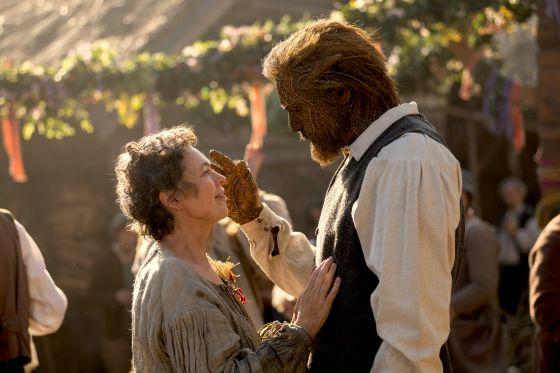
How indeed? It must not be right or natural, and because it is different and maybe even scary, it has to be bad. It isn’t a stretch to transpose this story into any number of settings where LGBTQ+ persons, immigrants, or any loosely defined “other” is experiencing joy in sight of those who aren’t. Wicker is more than just a message in search of a movie, though: it is a rich slice of life fable stocked with marvelous actors that bring each character to life.
The script plants a number of seeds in the background of its narrative to give this small community and its residents color, history, and pathos. Collar and carrot ceremonies associated with the nuptials tell the audience everything they need to know about the relationship the town has with marriage and intimacy, and passing conversations between neighbors fill in the rest. This all may take place in a long ago “once upon a time” fantasy setting, yet this is a world audiences know all too well.
Debicki and Colman deserve a great deal of the credit for this feeling of authenticity, with much of the movie revolving around their sparring for ownership of the community’s hearts and minds. Colman’s presentation of a woman outwardly confident and unflappable hiding a deep, desperate loneliness crackles with a startling authenticity that never breaks or wavers. Yet it is Debicki with the arguably more difficult role, as she plays the Tailor’s Wife with a deteriorating sense of self that seems to be fragmenting in real time as Wicker moves through its paces. She goes through several different phases of jealousy, sadness, anger, and spite that all feel authentic and knowable, giving the story a much needed counterweight for narrative balance.
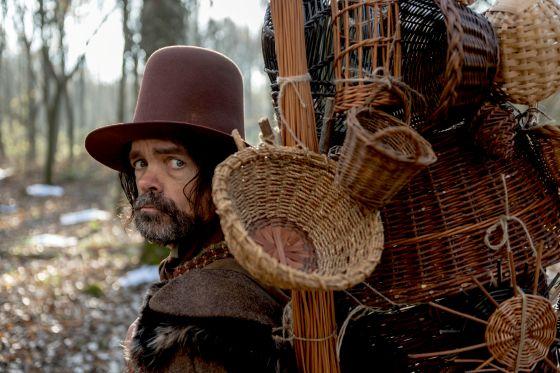
The wardrobe, hair, and make-up departments also deserve credit for bringing this world and its characters to life. The practical, in-camera effects that allow Skarsgård to (literally) inhabit Wicker Husband propel the audience into this universe, where a basket weaver creating life from scratch stops being fantastical after about five minutes, and just IS for the rest of the movie. Fischer and Wilson also aren’t afraid to venture off the soundstage and into the outdoors for their shots and set-ups, which likewise lends familiarity and authenticity to this fantastical tale.
Wicker is about all the ways that love infects people, interrogating the good and bad of this phenomenon in equal measure. Although Debicki, Colman, and Skarsgård lead the charge, the film enjoys plentiful character and narrative nourishment from each member of the cast: all of whom could support their own story. Rich, thoughtful storytelling that balances audacity with nuance propels the simple conceit into a tale that is more than just a love story, but is also a referendum on the best and worst aspects of the human condition.

“Obvious Child” is the debut novel of Warren Cantrell, a film and music critic based out of Seattle, Washington. Mr. Cantrell has covered the Sundance and Seattle International Film Festivals, and provides regular dispatches for Scene-Stealers and The Playlist. Warren holds a B.A. and M.A. in History, and his hobbies include bourbon drinking, novel writing, and full-contact kickboxing.

You must log in to post a comment.