



[Rating: Rock Fist Way Up]
In Theaters December 5
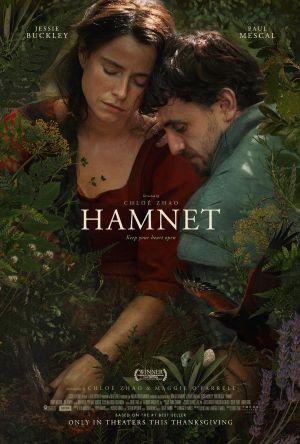
A lyrical exploration of grief, trauma, aging, and the power of art as a coping mechanism, Hamnet is devastating and impactful, sure, but it’s also a reflection of humanity’s core strength: resilience. An adaptation of the 2020 novel of the same name by Maggie O’Farrell (who is co-credited with the screenplay along with director Chloé Zhao), the film is an emotional synthesis of passion, pain, and love through its many forms. Honest, raw, and every inch as profound as the fiction it portrays, Hamnet challenges audiences to rethink not just what they know about the English language’s most famous drama, but the things that connect people from that era to this one.
Hamnet introduces Agnes (Jessie Buckley) in its opening minutes, who lives with her brother and stepfamily in Stratford-Upon-Avon, England circa 1590. Agnes catches the eye of local tutor and poet, Will (Paul Mescal), and the two are quick to fall in love, marry, and have a child. Pregnant again not long after, Agnes endures the departure of her husband to London, where he hopes to further his career as a playwright while his wife bears through another difficult labor: this time with twins.
The film jumps ahead about 10 years to show the state of the family in the earliest days of telework. Will is back in Stratford for what seems like the normal (short) interval between months-long stays in London, drinking up what precious moments he can when the family is all together. The bond between Will and young son Hamnet (Jacobi Jupe) is especially strong, which makes the boy’s sudden passing a short time later, when Will is again away, even more devastating. Mother, father, and siblings alike all mourn the child’s death, yet it is the way each family member processes and deals with that grief that informs the rest of the picture.
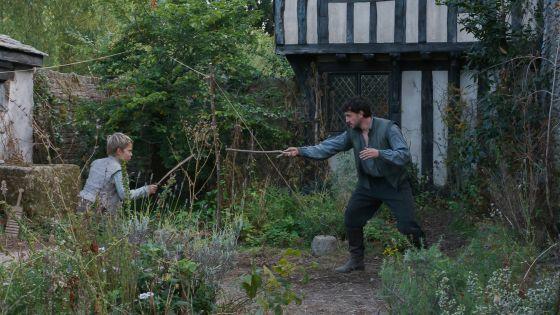
The scenes depicting Hamnet’s demise and his mother’s immediate reaction will endure in the memories of viewers long after the credits roll (a testament to Buckley’s transcendent and raw work in the picture), but it is the interplay between characters in the aftermath that serve as the narrative crux of the effort. This latter phase is no less visceral and painful than the actual passing of the child, owing much to the avoidable nature of its trauma. The loss of a child is perhaps the most devastating tragedy that can befall a family, and Zhao takes the time to demonstrate how, then as now, pain takes the form of an infection that sickens all it contacts. The ways Agnes and Will lash out at each other and those around them as a salve to their bottomless sorrow, the way they lose themselves in the fog and confusion of despair, this is what hits the hardest.
It’s interesting, too, because Agnes and Will are a study of opposition, making their almost immediate bonding and love something of a miracle. Zhao is consistent with her camera work and framing with each, opening the film with Agnes lying in a lush forest, practically spooning an ancient tree before linking up with her pet hawk. Will, in contrast, first appears to the audience indoors mid-Latin lesson, bound up by the strictures of a social system that both suffocate and nourish him.
Returning again and again to the close/wide shots of Will and Agnes (respectively) in their natural environments, the movie is composed more of mood than narrative, and allows the quietly observed moments to inform the “story” as it proceeds towards its shattering conclusion. Beneath all of this sits a sort of lingering indictment of the audience, who cherish Shakespeare and all his works, yet understand that it comes at the expense of Agnes and the children. How many untold generations have or will have the benefit of Will’s labors for the low, low price of one fractured 17th century family?
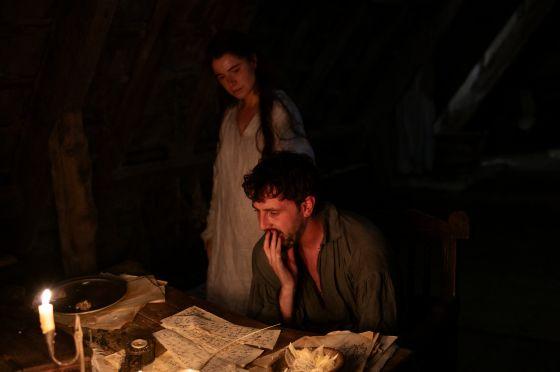
It seems like a narrative crossroads, a conflict, yet the power of Hamnet is its reconciliation of these two competing forces, and its hypothesis that they are not mutually exclusive. Will’s composition of ‘Hamlet’ the play provides him and the family an outlet for their grief, not only to feel it, but to give it voice and form, and it is this dénouement that elevates the picture to a level beyond stock and standard drama.
And while Shakespeare’s presence lingers over the whole story as something of a thematic anchor, it is Buckley who commands the emotional direction of the picture. Her portrayal of a woman battling the trauma of her youth as well as the stigma of her community is an essential component of her story when Hamnet’s birth and death force the woman to confront each in turn. Agnes’ journey through the labyrinth of grief and generational trauma is the engine of the larger story about a fractured family in crisis, and it reads as authentic and visceral because Buckley wills it thus.
A sparse score that builds in frequency and intensity as Hamnet approaches its conclusion pairs well with the almost ethereal visual presentation that Zhao creates with her long and wide shots. Less of a movie and more of a meditation on the emotional bonds that tie generations of people across the continents and epochs, it is an ambitious swing for any director or studio. Still, “though this is madness, yet there is method in ‘t.”
Indeed, Hamlet: indeed.

“Obvious Child” is the debut novel of Warren Cantrell, a film and music critic based out of Seattle, Washington. Mr. Cantrell has covered the Sundance and Seattle International Film Festivals, and provides regular dispatches for Scene-Stealers and The Playlist. Warren holds a B.A. and M.A. in History, and his hobbies include bourbon drinking, novel writing, and full-contact kickboxing.

Comments on this entry are closed.