



[Rating: Rock Fist Way Up]
In Theaters Now
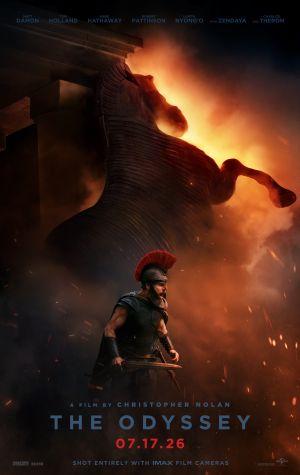
Christopher Nolan has done more than just make his best movie with The Odyssey, he has created the best surviving adaptation of a story with three millennia behind it, and in so doing, has also managed to synthesize and express his overarching artistic thesis. A staggering technical achievement on a level few filmmakers have approached, the movie is also an emotional body blow that reinterprets Homer’s epic in a way that makes it more relevant and haunting than it has ever been.
In classic Nolan fashion, the story is out of order and comes at the audience in patches that feature the present timeline, the very end of the Trojan War, and different portions of the journey of Odysseus (Matt Damon) in between. There’s also some pre-war flashbacks to color in the context of what was at stake leading up to the clash with Troy, and by some miracle, there’s never a confusing moment where one has to grope around to find their place in the narrative. Granted, most people know the basic bones of the story even if they don’t realize it, as the beats and details are baked into the crust of the collective western consciousness, yet Nolan still somehow makes it feel both familiar and exciting.
The present timeline is dominated by the queen of Ithaca, Penelope (Anne Hathaway), her son with Odysseus, Telemachus (Tom Holland), their loyal shepherd/retainer, Eumaeus (John Leguizamo), and the suitors vying for the kingdom in the absence of their king. Now ten years removed from the end of the Trojan War, and roughly twenty since Odysseus left, Penelope has rebuffed proposal requests for as long as possible while the suitors, including Antinous (Robert Pattinson) and Polybus (Corey Hawkins), grow restless. Greek custom dictates that Penelope and Telemachus provide hospitality for these suitors, yet this generosity has been exploited to the limits of cultural expectation, and if a decision about the vacant throne isn’t made soon, the queen and prince will be in very real danger.
As it is in the original poem, this narrative is broken up by flashbacks featuring Odysseus at different stages during his decade-long journey back to Ithaca, which include all the expected characters including Sirens, Giants, a witch, a whirlpool, and a Cyclops (among others). The journey takes a toll on the men Odysseus is trying to get home, and his chief lieutenant, Eurylochus (Himesh Patel), isn’t shy about his feedback in this regard. As the two timelines approach a collision with each other, fundamental truths about the war, Osysseus, and Nolan’s unique interpretation of both emerge, culminating in a devastating finale that illuminates more than just the full scope of the film and its characters, but universal ideas about the human experience that are as old as the poem itself.
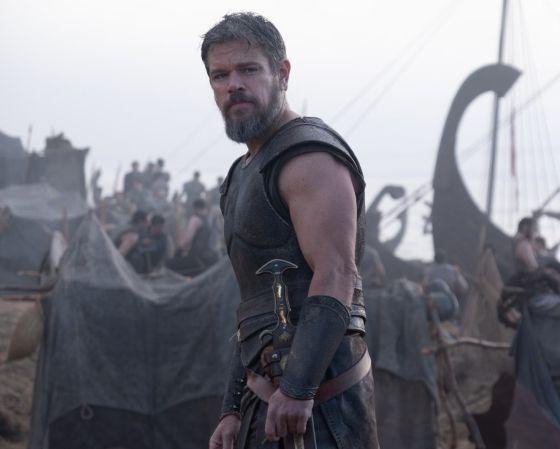
It’s not enough for Nolan to just tell the story of one man’s long journey home after a war, he wants to interrogate what’s lost when a person gives themselves over to the ugliest experience humanity has to offer. It would be too simple, too reductive, to call this version of The Odyssey a meditation on war, on survivor’s guilt and/or PTSD, because while it is indeed that, it is also an exploration of a broader theme within the director’s oeuvre. This idea that people are the authors of the horrors that haunt them, like Dr. Oppenheimer’s creation of the atomic bomb, or Batman’s “creation” of his rogue’s gallery, or even Angier and Borden’s escalations in response to each other: Nolan just can’t shake it.
By the end of The Odyssey, as the audience gets the last piece of the story and the key to Odysseus’ place in it, it becomes clear that Nolan has made more than just a statement about his understanding of the world and humanity’s fragile place in it vis-à-vis Homer, he’s completed a broad yet connected tapestry linking all of his work together. Even if the film was mediocre by way of hammy performances, terrible sound mixing, convoluted plot mechanics, and uneven pacing (so…Interstellar), it would still be a extraordinary achievement worth seeing. But that’s not the case. With The Odyssey Nolan has managed to harness his best instincts while minimizing his worst tendencies, and there’s not a bad minute out of the 172 total as a result.
Damon and Hathaway are as good as they’ve ever been in anything, here, and that owes a lot to their hefty share of screentime compared to the rest of the cast (Damon in particular). There aren’t many filmmakers that demand the respect (and role lust) that Nolan does, though, and that comes through in every single performance, regardless of the screentime they get. Pattinson and Hawkins make meals out of their sporadic appearances, as does Leguizamo, Patel, and Hawkins, yet it is the women in the cast that elevate the project by pure performance alone. Charlize Theron, Zendaya, Samantha Morton, and Lupita Nyong’o aren’t in the movie a ton, but when they are: holy Christ, watch out.
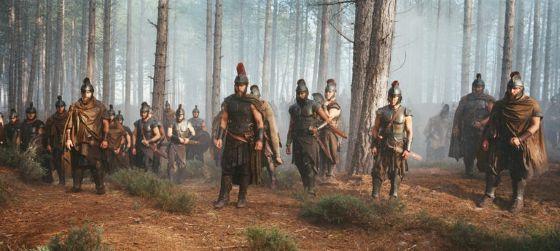
The stripped-down, mostly instrument-free score by Ludwig Göransson is piercing, unsettling, haunting, and every inch the atmospheric spine Nolan requires in his pursuit of the right balance of awe, inspiration, terror, and urgency. The director’s commitment to filming as much of the action practically lends a tactile feeling to these sequences, which come across as well-blocked and deliberate without feeling too chaotic or scattered. And while all of this is impressive, if not unexpected to a certain degree, Nolan’s greatest achievement here is the infusion of a modern, prescient urgency that makes this story feel as relevant as at any point in its history.
Odysseus’ struggle to reconcile the man he was before the war with the one he became as a result lies at the heart of this adaptation (the script for which Nolan wrote himself). The recurring ideas about how to treat guests, the gods, and even one’s self in times of crisis weave into the movie’s broader discussion about what’s lost when humanity gives itself over to its darkest impulses. This dialectic creates a rich tapestry upon which audiences can reexamine a very old and familiar story, and just for funsies, they can also look at it through the lens of the director’s full body of work, creating a deeper understanding still. It’s an accomplishment scarcely even considered before, and one audiences will be lucky to ever see again.

“Obvious Child” is the debut novel of Warren Cantrell, a film and music critic based out of Seattle, Washington. Mr. Cantrell has covered the Sundance and Seattle International Film Festivals, and provides regular dispatches for Scene-Stealers and The Playlist. Warren holds a B.A. and M.A. in History, and his hobbies include bourbon drinking, novel writing, and full-contact kickboxing.

Comments on this entry are closed.