



[Rating: Solid Rock Fist Up]
In Theaters Friday, March 20
The comforting embrace of optimism and fulfilled promise comes at a premium these days, making Project Hail Mary that rare case of a movie living up to not just its potential, but its moment. A veritable dream team of talent in all major phases of production, the movie is like a Hollywood fantasy draft come to life, and while that can sometimes create an environment where too much talent sucks up too little oxygen, that’s very much not the case, here.
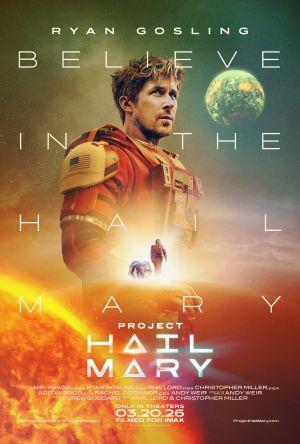
Project Hail Mary (PHM) opens in media res, with scientist Ryland Grace (Ryan Gosling) waking up all alone on a spaceship millions of miles from Earth. Grace can’t remember who he is or why he’s in space, though, and the answers to these questions come in mental fragments that he begins to assemble into a horrifying recollection. He remembers that alien microbes invaded our solar system and began eating away at the sun, a process that all the world’s scientists agreed would effectively kill the star and all planetary life within about 30 years.
Flashbacks reveal that Grace is part of a global initiative called “Project Hail Mary,” which launched a ship into space in the hopes that an anomaly on a nearby star, Tau Ceti, would lead to a discovery that could save our own sun. When Grace arrives at his destination, he gets the surprise of all surprises when an alien ship approaches and begins attempts at communication, leading to a friendship between him and a creature on the other vessel he dubs “Rocky” (voiced by James Ortiz). The film transitions into something of a science-forward buddy adventure from here as the pair work to establish a way to communicate and, ultimately, save the universe.

PHM is an adaptation of Andy Weir’s novel of the same name, and like his previous book and its movie adaptation, The Martian, the heartbeat of the story and the world it inhabits is science. Hopelessly idealistic and fantastical considering the 2026 state of things, sure, but Weir and this movie believe in the potential and promise of humanity as thinking creatures whose greatest asset lies not in our brawn, but our brains. And while PHM carves out plenty of opportunities for its characters to be brave and physically heroic, their creativity, composure, and compassion are the story’s ultimate assets.
That story gets a lot of help by way of its adaptation via Drew Goddard, who also brought The Martian to life and has managed to once again keep the book’s balance of whimsy against life-and-death stakes in perfect proportion. He’s aided in no small part by directors Phil Lord and Christopher Miller, Hollywood’s go-to directing tandem when a project needs to juggle action, millennial ennui, and clever comedy. There’s a lot of story to unpack through acts one and two, and plenty for Grace and Rocky to accomplish once everyone is all caught up, yet Lord and Miller’s use of largely practical effects and well-timed flashbacks keep the audience engaged and up to speed throughout.
Indeed, a weaker writing/directing team would have leaned on LED projection panels and/or green screen stages to keep the effort exposition-focused, yet they understand that the narrative, concept-heavy though it may be, is rooted in the emotional journey of Grace, Rocky, and their worlds. This requires practical, claustrophobic sets, real-world character interactions, and nuclear-grade charm and charisma that only a handful of actors can bring/sustain for two-plus hours.
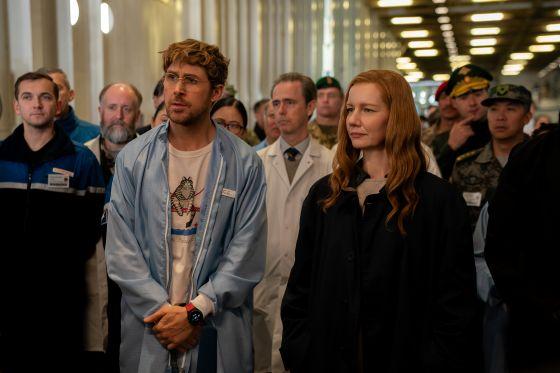
As luck would have it, Ryan Gosling is just such an artist. His turn as Grace feels like a cross between the good-natured cowardice he brought to The Nice Guys mixed with the cagey confidence featured in La La Land. He is somehow very smart, but never the smartest, charming without any hint of agenda, and relatable because (never in spite) of his flaws. Grace doesn’t always make the right decision and is hardly a mirror for the audience, yet Goddard’s script keeps viewers on his side every step of the way, using the commitment to science and hope as its narrative North Star.
If there’s any flaw in PHM at all, it is the hoarding of character development for Grace and Rocky alone. Even between these two, there’s little to know outside of the mission they find themselves on (there’s talk of “mates” at one point, but it’s fleeting), and even less for the folks on the periphery. This absence is felt most profoundly in the character of Eva Stratt (Sandra Hüller), the ruthless and pragmatic leader of “Project Hail Mary” who often plays the part of foil to Grace. Stratt is an important piece of the narrative puzzle and is made interesting by the immensely talented Hüller, but she’s less of a person, here, and more just a functional necessity of the story.
At a solid 153 minutes, one can understand why PHM is a bit thin in spots like these, however, and it never feels like it is at the expense of the larger effort. This is a big, years-long story packed into a breezy two and a half hours that doesn’t feel half as long as that. A pulse-pounding space adventure with equal parts heart and brains, PHM is a knock-down, drag-out good time if nothing else, and a welcome reminder of what can be accomplished in the name of cooperation and good science. In 2026, such ideas lean more “Fi” than “Sci,” but PHM dares to hope, and encourages the audience to do the same.

“Obvious Child” is the debut novel of Warren Cantrell, a film and music critic based out of Seattle, Washington. Mr. Cantrell has covered the Sundance and Seattle International Film Festivals, and provides regular dispatches for Scene-Stealers and The Playlist. Warren holds a B.A. and M.A. in History, and his hobbies include bourbon drinking, novel writing, and full-contact kickboxing.

You must log in to post a comment.