



[Rating: Minor Rock Fist Up]
In Theaters Friday, January 2
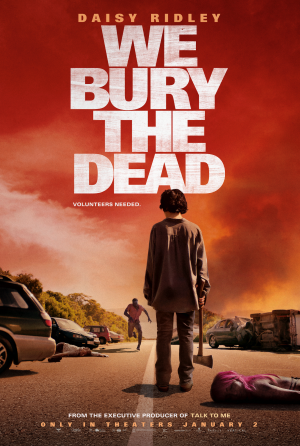
An exploration of grief, loss, and regret wrapped inside of a zombie movie, We Bury the Dead isn’t a bait and switch so much as a catch and question. This is a flick about the undead and a mini-apocalypse, sure, but the “creatures” in this version are a new take on the genre and are a compliment to the primary narrative rather than the engine of it. The results are somewhat mixed not because of this unique direction, but because the movie doesn’t seem to trust its audience to subsist on this stripped-down version on the material.
A quick cold open shows Americans Ava (Daisy Ridley) and Mitch (Matt Whelan) on their wedding day before jumping ahead some time later to a news report about a U.S. military experiment gone wrong off the coast of Hobart, Tasmania. An electromagnetic pulse killed half a million people on the island in an instant, necessitating a civilian clean-up effort led by the Australian armed forces. Ava lands at the volunteer mustering station in Devonport where she learns that rumors about undead reanimation are indeed true, but only in a very limited, docile capacity.
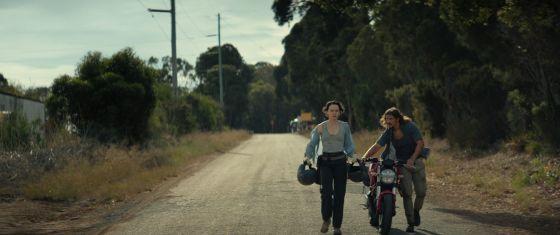
This revelation barely registers for Ava, who wants to get to the other side of Tasmania to confirm the fate of Mitch, who had a corporate retreat down there at the time of the incident. The military brass overseeing the cleanup keep volunteers like Ava and her new disposal buddy, Clay (Brenton Thwaites), on a short leash, however, and for the first few days, corpse collection is the name of the game. When Clay and Ava do manage to break away from the main effort, they find that like most zombie movies, those coming back “online” are only half the problem, forcing the pair to contend with the living and dead alike.
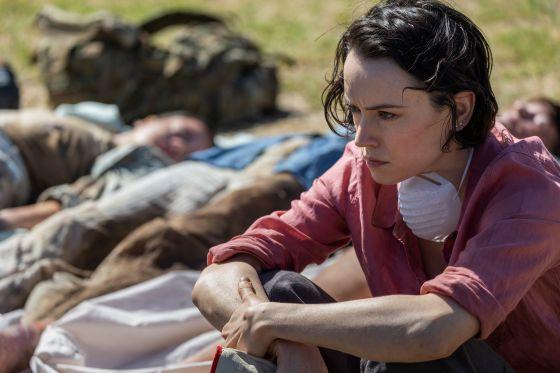
The first two acts embrace the stripped-down approach to the material with admirable conviction, and feature zombies that aren’t aggressive or infectious, but almost contemplative. A few lines muttered in passing early on establish that the military isn’t interested in learning the “whys” or “hows” of reanimation, erring on the side of quick termination when these semi-survivors appear. This casual disregard for the victims mixed with Ava’s flashback snippets throughout the movie create a very interesting conflict and character matrix for We Bury the Dead and its lead. It’s clear that Ava has unfinished business with Mitch, regardless of the state he’s in, and if she doesn’t get to him before the military does, it will remain unfinished forever.
As the film moves into its final phase, a lot of this good work is sadly undone by a flare up of classic zombie tropes and sequences that are admittedly well done, but out of place in the world the previous hour has established. The movie’s dénouement, so thoughtfully positioned by the flashbacks and Ridley’s outstanding work in the role, is overexplained in a not at all necessary monologue that follows. Like the zombie chases that occur in the back half, this lands with a thud, and feels like a concession by writer/director Zak Hilditch for the idiots not smart or patient enough to hang with a contemplative, untraditional zombie yarn.
Even so, there is a really good movie wrapped inside of this thing, due in large part to Ridley’s striking turn as the grief-stricken and regretful Ava. The movie’s slow drip of information about the state of her marriage just ahead of Mitch’s departure crossed with the fierce loyalty she displays to her husband’s memory is the engine of the story, and pairs well with the unique nature of the zombies in this version.
And while the production looks like a small one, the money appears to be well spent in both the practical and VFX realms. The costume and makeup/prosthetics departments also hit home runs for Hilditch, giving these characters and the world they navigate a genuine flavor. The composite shots showing the smoldering cityscapes on the horizon or the gnarly renderings of the plane crash on a beach highway look remarkable, and add a considerable amount of good, visual texture to this particular universe.
It just feels like Hilditch and the script are veering off onto the safer path in the third act, paving over a gripping emotional journey in favor of a smooth, well-worn, over-explained cruise down the zombie genre’s greatest hits highway. Ridley manages to hold the story together with her steely yet vulnerable turn as Ava, and the production’s department heads all made sure to put every cent of the budget on-screen to maximum effect. The good definitely outweighs the bad, here, but it also reminds a viewer just what was squandered in the rush to make sure no one got confused along the way.

“Obvious Child” is the debut novel of Warren Cantrell, a film and music critic based out of Seattle, Washington. Mr. Cantrell has covered the Sundance and Seattle International Film Festivals, and provides regular dispatches for Scene-Stealers and The Playlist. Warren holds a B.A. and M.A. in History, and his hobbies include bourbon drinking, novel writing, and full-contact kickboxing.

Comments on this entry are closed.