


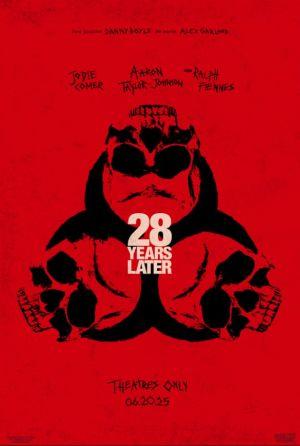

[Rating: Minor Rock Fist Down]
In Theaters Friday, June 20th
Misshapen, inert, and incomplete, there’s precious little about 28 Years Later that works, at least within the context of the movie itself. The third entry in a film series whose previous installments stood well enough on their own, this one feels like the first episode of a bigger story that’s only just getting started, here. And while frustrating, that might have still made it all worthwhile if 28 Years Later was well-paced, narratively coherent, and/or rich in character…which it very much is not.
A cold-open showing the early days of the rage virus’ spread gives way to a title card letting the audience know that the infection in Europe was halted, but that all of the UK is under quarantine and has been for the last 28 years. Those survivors unlucky enough to have gotten stuck in England, Scotland, and Ireland have been left to fend for themselves, which is exactly what 12-year-old Spike (Alfie Williams), his dad, Jamie (Aaron Taylor-Johnson), and mom, Isla (Jodie Comer), are doing in their small community: Holy Island. The township consists of a couple hundred occupants, all of them protected by a land bridge that disappears with the rising tide each day.
Jamie and Spike venture off-island as part of a regular community initiative that sees survivors take turns foraging for supplies, though this trip is young Spike’s first. Jamie uses the outing to school his son on different stealth, attack, and retreat techniques when coming into contact with the different types of infected, including a new variant: Alphas. Spike also learns about a survivor on the mainland, Kelson (Ralph Fiennes), whose rumored medical training plants a seed of hope in the young man’s brain as it relates to his very sick mother.
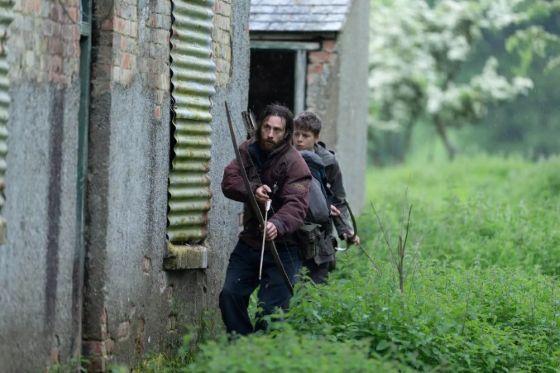
What starts as Jamie’s movie transitions into one about Spike, only to wrap up with a sort of coda that implies that this story belongs to neither one of them. Nothing about Spike and Jamie is particularly unique or interesting, and their adventures with the infected don’t offer anything new with the exception of the Alphas, whose intelligence and semi-sentience kind of take the wind out of this franchise’s sails. The idea that the zombies of this universe are a byproduct of a virus that taps into humanity’s rage (and the fact that they are fast) is a unique staple of the “28” series, and the Alpha development kind of ruins both.
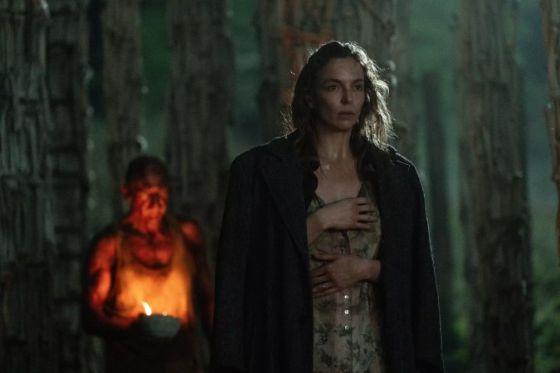
Worse still, the script waits until the last act to trot out Kelson, its most interesting character, who introduces some intriguing ideas about this world that are promptly abandoned (along with Kelson himself). And while there is an interesting, messy family dynamic between Jamie and Isla that prompts Spike to take action in the back half of 28 Years Later, there isn’t any payoff to what’s set up, and is more just a launching pad for Spike’s adventures. Cormer and Williams are wonderful together as an on-screen pair, and Fiennes increases the whole effort’s batting average with his limited screentime, but all the good acting in the world can’t salvage what is effectively the (bad) opening episode of a new trilogy.
Early in the picture, there’s several quick cuts and music queues that pull the audience out of the story and into old movie footage showing English archers battling attacking armies. It’s a persistent first act motif that seems to tie the events of this story to England’s storied military history, and repeated confrontation of long odds in battle. It’s an interesting choice, made even more so by the fact that director Danny Boyle and writer Alex Garland fail to connect Spike’s story to this thematic anchor in any way whatsoever (at least in this installment). If anything, Spike’s story is about the courage of an individual abandoning community, which stands in contrast to the interstitials showing legions of armored knights gathering in common purpose for an attack.
Even more disjointed and incomprehensible is the action, which seems intentionally anticlimactic at times, if not an outright tease. The film often puts Spike or the other characters to sleep at the tensest moments, robbing these set-pieces of their urgency. There’s a fair amount of gore (including one reminiscent of a Mortal Kombat fatality this review won’t spoil), yet this too often comes across as borderline taunting with the set-ups. Close-ups or repeated shots of dripping fluids, a bloody bag, or ominous crows hint at impending importance, yet in almost every case they fail to develop into anything.
Indeed: this movie is one big (Chekov’s) gun that never fires. Boyle and Garland aren’t hacks, though, so one can and probably should hold out hope that future installments fire the bullet/complete this story and engage with the various threads that 28 Years Later introduces. That doesn’t do this movie any good right now, however, nor will it comfort those headed into this one expecting the same dynamic action, rich character development, and narrative consistency of the previous two entries.

“Obvious Child” is the debut novel of Warren Cantrell, a film and music critic based out of Seattle, Washington. Mr. Cantrell has covered the Sundance and Seattle International Film Festivals, and provides regular dispatches for Scene-Stealers and The Playlist. Warren holds a B.A. and M.A. in History, and his hobbies include bourbon drinking, novel writing, and full-contact kickboxing.

Comments on this entry are closed.