



[Rating: Swiss Fist]
In Theaters and On Digital January 30
Compressing 14 years of litigious, bureaucratic, deeply personal history into a 131-minute movie was never going to be easy, and the people behind Pike River should be commended for their attempt at just that. A dramatic exploration of the 2010 coal mining accident and its long tail aftermath, the film starts strong, then locks into something akin to a washing machine spin cycle, with characters and ideas churning up, down, and all around in endless, familiar spins.
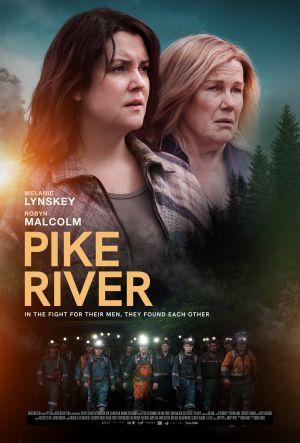
Pike River starts with the workers of the eponymous coal mine getting ready for that day’s trip into the dark depths. Sonya Rockhouse (Robyn Malcolm) has two sons on-site, while cancer survivor Anna Osborne (Melanie Lynskey) bids farewell to her husband, who isn’t feeling well but resolves to go below anyway. Sonya and Anna are just two of the more than two dozen that are notified later that day about an explosion in the mine, which they eventually determine has trapped 29 men roughly 1.5 kilometers from the entrance.
What little hope there is for the rescue of the more than two dozen miners turns into a heartbreaking plea for the recovery of their remains after just a few days. The company that owns the mine has a number of reasons for keeping it sealed following the accident: some good (safety concerns), some bad (costs, potential discovery of evidence proving neglect). Pike River uses Sonya and Anna as the narrative focal points through the second and third acts, focusing on not just their grief, but their fight against the mining company and government to get justice and respect for the fallen.

The movie follows Sonya and Anna’s struggle for the better part of ten years, and there’s no shortage of drama to squeeze from each woman over that span. Malcolm and Lynskey are superb as two exhausted yet determined women who don’t just fight corporate and governmental bureaucracy, but also each other, the other victims, and even their own families. Director Robert Sarkies allows the story to breathe long enough to give these women moments of doubt and humanity, affording Pike River a genuine, lived-in texture.
The straightforward timeline approach doesn’t help the narrative, however, which feels like it sputters to a stall every time it gets going after the first (tight) thirty minutes. Every minor victory or “win” is followed by a back-to-square-one setback, and while it may be an accurate representation of what the families were going through in the seven or eight years following the incident, it doesn’t make for very compelling drama. Indeed, for about an hour and fifteen minutes, Pike River feels like it is just going in circles, piling disappointment and misery on the backs of Anna, Sonya, and the audience.
It doesn’t help that the script by Fiona Samuel isn’t sure what kind of story it wants to tell. Is this an investigative legal drama about finding justice for the fallen, a community movie about the plight of those left behind, or an exploration of grief, loss, and friendship? The short answer is that the movie attempts to be all of these things, thinning the narrative soup of the larger effort and robbing many of the scenes of any real emotional punch. A number of interesting characters float in and out of the movie for a time, like union advocate Helen Kelly (Lucy Lawless) and attorney Colin Smith (Stephen Papps), yet Pike River returns again and again to the comprehensive timeline of disappointment and despair, exhausting the audience right alongside Sonya and Anna.
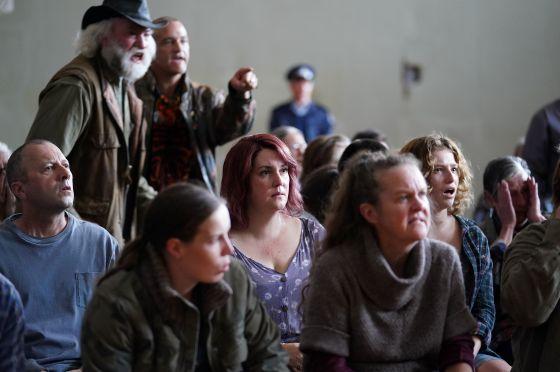
Besides making for a boring watch, it seems like a waste of a dramatic platform for interesting discussions that force these characters to stretch a bit. Although Sonya, Anna, and many of the other family members make compelling arguments for wanting the mine reopened to collect remains and investigate the incident, the very real potential of further injury and death for those going back in is just kind of hand-waved away. Is closure and a vague sense of justice worth another human life; what about 10; what about 29?
Exploring questions like these might have been a better use of the two-plus hours Pike River spends telling its story. Also, for a country as lush, colorful, and geographically diverse as New Zealand, one would expect the visual look of the film to feature more vibrancy and space: two things absent, here. Much of the color is washed out, and a person might be forgiven for thinking that the sun never shines south of Australia based on the lighting schemes employed by Sarkies and his crew.
It is just disappointing, because there’s a compelling, topical, and important story lost somewhere in this jumble of themes and history, and several great performances on display to boot. Very little of it comes together, however, and the moments that do lose much of their punch due to the excessive narrative repetition. Maybe one day someone will figure out how to pull all of this history, technical information, family grief, and bureaucratic insanity together in an interesting, compassionate way. Until then, there’s Pike River.

“Obvious Child” is the debut novel of Warren Cantrell, a film and music critic based out of Seattle, Washington. Mr. Cantrell has covered the Sundance and Seattle International Film Festivals, and provides regular dispatches for Scene-Stealers and The Playlist. Warren holds a B.A. and M.A. in History, and his hobbies include bourbon drinking, novel writing, and full-contact kickboxing.

Comments on this entry are closed.