


Say what you will about the manipulation of facts in a Michael Moore-directed documentary, but the man knows how to tell compelling stories. Critics accuse him of hogging too much face time, mounting attack interviews, and staging publicity stunts, and they would all be right. But his films resonate. Not only does Moore cover hot-button issues in his films, but he has an uncanny ability to tap into a collective consciousness. He does this by telling stories.
Larry Charles and Bill Maher have a similar ferocity with which they attack the tenets of organized religion in “Religulous,” but they still have a lot to learn about what makes a movie engaging from beginning to end.
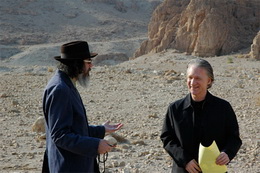 Charles is best known (now that “Seinfeld” is off the air) for directing “Borat,” that shocking, masterful satire of American culture that was such an unexpected hit two years ago. But he inherited that movie from another director, and had a star (Sacha Baron Cohen) and writing team (nominated for an Oscar) who had already pioneered the film’s fake-reality docudrama style on a TV show (“Da Ali G Show”).
As director of “Religulous,” Charles strings together a series of interviews that Maher conducts with religious leaders and followers from all over the world. As director, he is often seen on camera, accidentally in the background of a take or maybe on purpose—the reasons for it don’t matter. What does matter is that it is indicative of the sloppily thrown-together mess that’s passing for a movie here—which is not to say there isn’t a lot of interesting material covered during the film. There is.
Maher isn’t just skeptical of the existence of God, he is downright appalled at the way that religion has ingrained itself into the fabric of society. The talking snake and Garden of Eden legend pass for “fact” these days, and that makes Maher sick. This is the true face of normalcy? Each interview that he conducts starts out politely enough, be it at a portable chapel in a truck stop or a creepy theme park dedicated to Bible stories, but it is apparent that he’s just waiting for something to offend him so he can turn on his angry stand-up routine.
It is a good routine. At his best, he has the bewildered incredulousness of George Carlin. At his worst, he’s as self-righteous as his targets. Maher has his Bible facts down. What is unsettling about the movie is that his subjects, as a general rule, don’t have theirs. The biggest feeling I took away from the film isn’t a new one, but I am surely convinced of it now. Very few people really know what the Bible says—they just use it to fit their means and goals. Hate gays? Proof in the Bible. Love gays? Proof in the Bible. The one thing we can definitely count on is that the book was written and changed by countless numbers of authors and can be interpreted in many different ways. That makes believers who think they are sticking to the ultimate “Word of God” look even more ridiculous.
 So Maher has a pretty easy time making fools of fundamentalists. Many hang themselves with their own rope. There are enough effective interviews—where Maher’s subjects don’t even realize how hypocritical they are—to make “Religulous” more than a passing curiosity and a true reflection of our current regressive culture. The problem is that Maher comes off just as pompus as the pious mass he is confronting.
When Maher does get an interviewee who is aware enough to admit and joke around about the inconsistencies of the good Book (there are at least two of these people in the movie), Charles cuts the interview short and moves on to easier marks. A deeper look into the contradictions of ancient texts and modern beliefs would have been nice. Just finding out how church leaders balance their faith with the hard-won facts of science would have made “Religulous” more than a pissed off skeptic’s stand-up routine.
But if the release of this movie opens doors to a debate that most of the world seems unwilling to even approach, then perhaps “Religulous” has accomplished something. It’s too bad, though, that it could have been so much more effective with some actual stories to draw an audience in.

Eric is the Editor-in-Chief of Scene-Stealers.com, a Rotten Tomatoes-approved critic, and contributor for The Pitch. He’s former President of the KCFCC, and drummer for The Dead Girls, Ultimate Fakebook, and Truck Stop Love . He is also the 2013 Air Guitar World Champion Mean Melin, ranked 4th best of all-time. Eric goes to 11. Follow him at:


{ 18 comments }
You missed the main point of the whole subtext of Maher’s message: it’s not just that most religions are based on falsehoods; it’s far more important that religious beliefs have been and continue to be the source of most of the world’s worst problems. They are the source of most of the true immorality in the world and could possibly be responsible for the demise of mankind, through wars and environmental damage. Of course there is good done in the name of religion – no one denies that, but religions are hardly the keepers of the moral flame they would have you think they are
I agree with Maher’s point, and you’re right, I didn’t go into religion’s moral consequences in my review. But I don’t think that was necessarily a subtext. He spent quite a bit of time throughout and especially at the end of the film spelling that message out and driving it home.
I thought this was a very good movie…
It’s true that most of the people Maher talked to in this were what should be considered as “extreme” Many of them, you’ll also notice, said things like, “What kind of documentary are you making?” (which may bias some people to think that the manner in which this film was made was unfair, and one-sided)
**HOWEVER**
In my personal experience, there are actually very few Christians whom will actually sit down with you and have an INTELLIGENT conversation about Christianity, if they know that you have legitimate doubts to be addressed. In fact, when a valid point is brought up…it’s soooooo easy for them to say something like, “well that’s where FAITH comes in!”
And, honestly, there’s no REASONING with someone when it gets to that point. This movie isn’t going to make Christians, Muslims, Mormons, or Catholics just up and change their views…start questioning…go on a mission to stop religion, etc But will ANYTHING???
No. Nothing will…because even if someone goes out and KILLS ANOTHER PERSON, all they have to do is say “the devil got to me” and go on about their everyday business, because God will forgive them if they’re saaaaaaved!!!
True, there are things in the Bible that are good. Good qualities to have, good ways to live, sharing, thinking of others before yourself, etc… However, (like Maher said) THESE ARE COMMON SENSE!!!
In my opinion, the Bible was made to try to keep people in line during their lives, and that’s it. The fear that they’ll burn for eternity will keep believers from going all ape$hit. People don’t make decisions for themselves, because “it’s in God’s hands…He’ll tell me what to do.” Now, God’s become so much of a cop-out, it’s ridiculous!
Let’s just have a damn televised Religious Debate, and get this over with. Only people with common sense are allowed to vote.
I’m finished ranting…go see the movie. I give it a 5-Star rating
If anything, I was more than a little disappointed that Maher wasn’t harder on his interviews,since there are many, many questions he could have asked which could have elicited the nonsensical nature of religion. And I would have been thrilled to have him interview some serious theologians on the subject, which would served only to further highlight the absurdity of their stance. Here are some questions I would have liked to have asked some of his interviewees:
1) Doesn’t the sheer multiplicity of separate religions strongly suggest that (a) they are almost all convinced that they alone have a lock on the truth and yet, (b) clearly, none do?
2) There are over 23,000 different Protestant churches in the US alone, each differing from the other in beliefs about things like total immersion, musical intruments used in the church and the like. Doesn’t this suggest that they can’t all be right, and that they bear little resemblence to the early church?
3) Doesn’t the marriage of conservative Christianity and right wing politics bother you at all? Does that mean you believe God has to be a Republican? And couldn’t be a Democrat?
4) Doesn’t the existence of this alliance (conservative Christianity and right wing politics) have more to do, at its heart, with racisim than with anything else? How else would you explain the fact that it began immediately after the 1964 elections in which the Republicans carried two Southern states for the first time for the simple reason that they were disgusted by Lyndon Johnson’s announced decision to proceed with his Civil Rights agenda?
5) And doesn’t it bother you that the issues of “God, guns and gays” were added to the issue of racism, producing the “family values” bloc we have now, the heart of which is in the Bible Belt which is the lowest in the country in terms of levels of education but highest with regard to any index of disorder you might care to name?
6) What does all this have to do with Jesus? Does anyone seriously propose that Jesus would be in favor of capital punishment? Of elective wars? Of opposing raising the minimum wage? Of being anti-union? Of conducting ones life as if hanging onto every dollar was what it was all about?
7)Where did God the father come up with a son? And if he loved him so much, why did he send him to suffer and die? So he (the father) wouldn’t be angry any more? And how is it that the maker of the Universe even gets angry? Of makes mistakes? Or is jealous? This is not even a good myth.
8) You may be tempted to write these questions off as coming from a crank, but I can assure that I’m as serious as can be and really would like to hear the answers. Make me an argument that supports Christianity and I’ll listen.
I’m not a religious person and I didn’t see this movie but I have answers for Joe Monroe’s questions.
1) You may call this answer a cop-out but, really, facts concerning the stories of religious beliefs are not as relevant as the messages conveyed in those stories. Each culture conveys different morays that their respective religions represent, hints indifference.
2) It doesn’t matter if they’re all “right” as long the people who attend each church accept the beliefs of that church to better their own lives. The original church had to work for the people of its time. This answer works for question one as well.
3) Religion and civilization go together like bread and butter; one could easily argue that one can’t survive without the other (they are both systems of control). In my opinion, conservative politics with concerns to morals tend to tilt with the idea that maintaining the original (traditional) beliefs of society are more important than changing (reforming) them. A society built on morals that are based in a religion (which they all are) is constantly under threat from a political base based in reform (liberal or left-wing politics). It does not imply that God is a Republican (God wouldn’t have a political agenda) so much as it says that God’s will is law and therefore can’t be reformed.
4) This is more of a direct attack on American Christianity than on religion in general. Still, I would say that this answer relates directly with the answer to question 3. Our civilization is based in slavery followed by segregation. Lyndon Johnson’s Civil Rights agenda threatened the moral base.
5) Again I say MORAL BASE. You and I may share political beliefs that support reform but not everybody does. Also- “…Bible Belt which is the lowest in the country in terms of levels of education…” I THINK that this is simply an incorrect statement. I’m not strait up calling you wrong. I would simply imagine that America’s biggest education issues reside in the inner city schools around the country. I could very well be wrong. Let me know where you got your information.
6) Christians believe that Jesus is the Son of God and, um, God. Capital punishment is an ethical issue and no one can really know how Jesus felt on this issue. He was, of course, executed. Religion is a system of control and ethics. From the control standpoint it makes since that God would strike down the “wicked”. The “wicked” can be adjusted to meaning the enemies of the state. The issue of rather man or God alone has the right to do the judging and striking down is an issue argued among Christians (as well as other religious groups) all the time. A lot of Christianity talks of compassion for the poor. A system of control could never be on the side of the lower class (including small issues like minimum wage or unions). It all depends on what people believe religion to be.
7) You and I will never see eye to eye with Christians on this issue but I can give you the answer I think they would give. He loved mankind and sent his son to suffer and die to make up for our sins and imperfections as mortal beings. But if God is perfect and can’t make mistakes then I ask why are humans, one of his creations, imperfect? God made us with the potential to be perfect beings and we failed him and sinned. Does that answer really make sense? No. Sorry, it’s the best I can do with that question. You probably have them hands down on this one.
Ser your answers to his questions/comments are just silly, I will just give one example – you said no one can know what jesus’s thoughts or beliefs on capital punishment would be ? Say what ! oh please if you think for a minute jesus would be for killing in any way huh well I think most here would know the answer to that – turn the other cheek, treat others,change your enemies mind, forgive, help each other, ect… The things people are taught about jesus should give one the answer with little thought. In reallity I think all religions are bunk so in reallity maybe jesus would in some ways be for killing someone, lets say someone kills his mother would he want that person to be killed ? All I can say is with the teachings of this man and thats all he was a man plain and simple we would have to say he would not be for capital punishment, no way !
Where does one start, with a man like Bill Maher, and a film like Religulous? Maher accomplishes the same thing a man like Ben Stein accomplishes in Expelled, capturing, “got ya” moments on camera with out letting the interviewed offer an explanation. Better yet, like Expelled, Maher interviews those that seem least fit to represent the view he opposes, and passes them on to mis-informed viewers as the “brightest of the bunch”! This is seems to be evident with Maher’s belief in the relationship of Jesus Christ and the Horus story of Egyptian Mythology. This view is brushed off by most scholars, including liberal theologians and Near Eastern scholars. Check out links below
http://www.gregboyd.org/blog/religulous-and-the-alleged-horus-christ-parallels/
http://www.bringyou.to/apologetics/HORUS.htm
One gives an honest review of the movie, while deals nicely with the supposed Christ-Horus link.
Moving on the statements that equate all of the worlds evil to religion is not only ridiculous, but logically flawed. Pol Pot, Stalin, and the current Chinese government, give modern examples of evil being commited without religion added into the equation. I wonder when people will start trying to define or sum evil up with various world views, and realize that evil exists accross lines of religion and social class. Evil is a fundamental flaw, an element capable of being actualized in every human being. Which seems to provide us where the rubber meets the road moment! Is their hope that evil can be resolved, or will it always and forever exist.
The statement
“In my opinion, the Bible was made to try to keep people in line during their lives, and that’s it. The fear that they’ll burn for eternity will keep believers from going all ape$hit. People don’t make decisions for themselves, because “it’s in God’s hands…He’ll tell me what to do.” Now, God’s become so much of a cop-out, it’s ridiculous!”
This line of thought doesn’t seem to match up well with the first 400 years of Christianity. Surely, if Christ was destined for execution he may relent on what or who he thought he was. And the ferocity in which the Roman Empire excuted their persecution would follow this reasoning, but I suppose they were being fed to lions, crucified, and tortured, you know to control people.
I find too just as much as some non-believers do, the at times ridiculous comments people makes when I feel I have raised questions or made comments that seem to counter their remarks. Comments like, “well what is true to you doesn’t have to be true to me” or “well I personally believe that” come to mind.
Finally the constant association and obsession of conservative Christianity in bed with Right-Wing politics is beginning to become out dated and tired. This group, like the Islamic extrimist represent a very small group of each religion, sadly it is the squeakiest wheel that gets the most grease.
Many New Testament scholars hold the view that Christ never intended to create a Christian Nation, so asking the question whether Jesus is a republican or democrat, seems to be misguided and off based. In fact Jesus states, “that you can only serve one master God or Caesar” not both. Christians are called to live in the world, and not to be of it, this seems to negate the idea of legislating beliefs and morals within the structure of government. Anyhouw just a few thoughts.
In my review, I wrote: “A deeper look into the contradictions of ancient texts and modern beliefs would have been nice.” Glad to see it is happening on this post.
I haven’t seen the movie yet; but I intend to do so. I suspect there will be much with which I agree, in spite of the fact that I consider myself to a Christian.
I just wanted to comment on this sentence: “The one thing we can definitely count on is that the book was written and changed by countless numbers of authors and can be interpreted in many different ways. That makes believers who think they are sticking to the ultimate ‘Word of God’ look even more ridiculous.”
Yes, what Christians call the “Word of God” was written by multiple authors (at least 40, possible more). However, archaeological evidence show that over thousands of years the manuscripts have remained virtually unchanged (not including the occasional copyist error of leaving out or mis-spelling a word). Heard of the Dead Sea Scrolls? They demonstrated that the Jewish Bible (Christian Old Testament) remained the same for at least 900 years. There are over 5,000 ancient Greek manuscripts and over 19,000 ancient translations (Syriac, Latin, Coptic, Aramaic, etc.) and compared side-by-side there are no obvious (or intentional) alterations or changes.
Proof that the Bible is the Word of God? Nope. In the end, that truly is a matter of faith (as are all things – we all have to choose our own worldview partly on facts and on how we interpret those facts, which calls for faith). But the evidence, and it is documented and not junk science or junk legal defense, the evidence at least shows that the Bible I’ve got in my house today is the same Bible Christians used 1700 years ago (Council of Nicea) and the books are unchanged at least as far back as the 1st Century AD — and a little before then (Septuagint Greek translation of the OT is dated around 200 BC, Dead Sea Scrolls anywhere from 2nd Century BC to early 1st Century AD, earliest copies of the Christian Gospels to late first Century AD).
As far as interpretation of that Bible goes – you’re right in saying people read all kinds of things that may or may be there. And sad to say, too many Christians don’t know their Bibles well enough to defend the positions they take – right or wrong.
I would like to know what you think of some of your christian brothers and sisters, in this I mean the scientologists, the christian science, the seventh day adventists, the mormons, the jehovahs witnesses, the snake handler bunch I dont know what branch of christianity they are but they are in the same bunch in my opinion, there are many I am forgetting. Then we have the belief in noahs ark this is so crazy that any person who believes this is true is just so ignorant they need to go to school in finland and get an education, the same with adam and eve, the same with virgin births, hey mary either got some penis or she did not get pregnant, jesus coming back from the dead, humm I dont think so. god making man in his image, again what would an intelligent alien think of this belief ? and oh anyone who thinks we are the only intelligent beings in our galaxy with over a 100,000,000 other suns and then there are a hundred billion other galaxies many of which are hundreds of times larger than our small galaxy, some galaxies have a trillions other suns, the amount of chances for a planet like ours with life on it is so enormous that anyone who thinks were the only intelligence in the universe is just plain nuts. bonobo chimpanzes have 98% the same DNA as do we humans and they have a much better short term memory than we humans but hey evolution cant be true ya rite ! I often wonder things like why would a god of infinite power and knowledge who wanted to rid a world of evil humans go about it by making it rain 40 days and 40 nights and to think even this amount of rain would be enough to cover the highest mountains, hey if there were that much water on our planet it would totally change the gravitation or our planet and our obit would change. If god were all powerful and made no mistakes how could evil ever come to be and lets say god makes mistakes, cancer,birth defects,diseases,hate, but anyways back to noahs flood, why go through all the trouble of this when god is all powerful he she it could just think it to be so, make it so, all the evil people would be gone, all the animals who would die in a flood would be spared drowning, come on doing this with a flood is stupid, messy, and just not the way an all powerful being would work, come on dont try and use ” god works in mysterious ways “
to rcm and joe monroe:
I could go on and on about answering your questions, but I think if you went to church or talked to a priest or a religious leader they could do a better job than me but…
I really thought your views on your question #7 were very skewed and illogical. God sent Jesus Christ His son to earth to die for OUR sins. Yes, God made humans and we had the potential to be sinless and perfect, but Adam committed a mortal sin and CHOSE to go against God’s word. This gives every human being choice and freedom. God knew this would lead to a number of sins, and so he sent Jesus to become man. Jesus never committed a sin and therefor when he was killed he could open the gates to Heaven for everybody else. This is the reason, to open the gates of Heaven for us. God was not mistreating His Son… Everybody on earth is His son or daughter.
Science can also be tested… Wasn’t Pluto a planet a few years ago? What I’m saying is nothing that happened thousands of years ago can be factual because not one of us can even comprehend a thousand years… Religion can always be tested, which is why Faith goes hand in hand with Religion. But who is one person to challenge a belief of billions and billions of other people? Seems ridiculous to me.
Really seems like all of these religion-challengers are actually just curious, and no you can’t find every answer in the Bible. So I urge you to please try talking to a priest or a pastor, I’ll bet they’ll have more to tell you than some ex-satanic trucker priest or a marijuana-worshiper being interviewed by Bill Maher…
God bless you all and I pray that you find Him in your life.
Super-Duper site! I am loving it!! Will come back again – taking you feeds also, Thanks.
I was working at a local grocery store on the night shift,we had the radio on and the song by led zepplin (the stairway to heaven)came on,and this grown man went running up and flipped off the radio,I asked him why did you do that? his reply was “you can go to hell by listening to that song” my manager came along and turned it back on and the guy ran outside.This is what religion does to people its insane that anyone could fall for such a sham.I will never forget my first confrontation with religion,I was a goung child and was told the story of noah’s ark,I thought to myself how could this be possible? it cant be done.Where is common sense people geez just think it through its so easy to see, hell I am stupid and I figured it out years ago.
will anything change their views ? There are a few things that can change a religious persons beliefs, one is education in certain branches of science, astronomy,cosmology, in this I mean how our universe came to be, how our planet was formed,the age of our universe our planet,all the myriad types of life in our planets past. It helps if the person can learn these things from television shows like “the universe” “stephen hawkings universe” “the planets” and many more such shows. Actually seeing how stars first formed and from these first stars that exploded and created the elements that would go on to form our planet and our bodies. To see and know the emmense amount of time it took for life to evolve into ever more sofisticated beings, seeing it happen in these ways can put to question a persons beliefs in such nonsense as noahs ark, adam – eve, the age of our world, speaking of evolve ? a few shows explaining how evolution works in detail can also help to cause question in crazy creation myths. I could go on all day here but education especially when a person is young can give one a “vaccination” an immunity against such crazy religious ingnorance of real facts. There is one other way a person can lose their religious beliefs, this way is the quickest and hardest it takes pain and suffering, in this I mean in certain situations like when jews were put in nazi camps to suffer greatly before death, many of them prayed for months on end, millions were praying at one time and yet their god did nothing, many finally said ” there is no god ” also in wars some who are true believers some are pastures,priests ect and they are killed, this can change beliefs for some. At this time in my life I know a man he owns our home, he and his wife are believers and she now has blood cancer, he is now asking questions ? why would god take my wife ? why would god create such a thing ? He also recently lost his daughter to a heroin overdose, this also brought questions to his mind, he is in a process of losing his beliefs will he do it ? I am not sure yet he is having these thoughts and the answer that most believers will say ” god works in mysterious ways ” is just not a good enough answer niether is ” one must have faith ” !!
You make very good points ! One that really has me upset is your idea which is fact, our republican party is a bunch of religious hippocrits. They all hate science, why would they dislike science ? I will try and explain, science is based on facts religions are based on faiths. Science has over and over shown their beliefs to be nothing more than ridiculous myths. It all began when bruno said the earth was not the center of our universe, he was burned at the stake. Then there was galileo he used his telescope to show our planet was not the center and he was put on house arrest for the rest of his life, again by the church and believers, he died never waivering from his find of facts. Then there was darwin and his evolution all based on facts, this one republicans still say is just not true. They call it a “theory” this word the believers love to use, it should be explained to them in detail. One reason science began to use the word theory is because of albert einstein, for 200 years newtons ” laws ” on gravity were thought to be total fact and they were in most cases, then albert came up with his special then general “theories” of relativity. The idea of laws was changed because for so long it was thought newtons gravitation was fact and it was found not to be fact in all cases so now science uses the word theory just in case some new tests or new findings prove somthing to be wrong. So the word theory is a believers weapon against science and its just like a typical believer to be ignorant of somthing. The republican party should be called the party of the ignorant, they really hate all sciences. Take climate change its one of their things to hate and it shows their ignorance in full color. We have glaciers melting at a rate not seen for millions of years, its so easy to see yet again they are blind to facts staring them rite in the face. some will say oh its happened in the past so why do anything about it ? its a natural thing. Ya it has happened in our far past and the north and south poles were melted,gone ! The sea levels were hundreds of feet higher, billions of people would be under water. It sickens me that creation can actually be taught in any of our schools, when I think if this it causes me to remember pictures of young children in some arab countries being taught by angry crazy religious nut case muslims exstremists, taught to memorize the koran bowing and reading for hours on end, while being told the united states is the enemy. Its all a bunch of crap ! all of it, just like the poor muslim children some of our children are being taught utter crap which will close some minds forever. There must be some difference in people who believe in this nonsense, not the ones who are never shown any evidence that what they were taught was bunk but the ones who are shown both science and religion and still go with the religion, in my opinion they are just not as bright and more gulible, hey its much easier to just say god did it and be done with it they must be missing somthing maybe curiosity ? Some are just not curious of anything and not having a curious mind to me is a tradgedy. As bill maher often says ” united states citizens are stupid ” and compared to many many other countries our children and adults are so far behind in math and science that in many ways the rest of the world is leaving us to history. I was an auto mechanic for many years, one day in the office I asked our car computer diagnostics guy if he knew what the stars in the sky were ? He said they are lost souls ! I said no really do you know what they are ? I thought he was joking, he was not joking he had no idea what the stars in our night sky were, I thought this was a pretty bright individual yet he had no idea that stars are just other suns some larger some smaller, I thought it was common knowledge I guess I was wrong. This amazed me and saddened me, if you were to ask a 10 year old kid from say finland you would have got the right answer, how sad how maddening we should be ashamed at this ignorance.
Steven you must be a believer its pretty obvious I think. First you say ” a man like bill maher ” this sounds like you dislike him rite off the bat, well bill is a kind man generous loves animals ect… He just dislikes all religions for this you seem to dislike him. Then you state bill or someone said ” all of the worlds evil comes from religions ” maybe it was said yet if asked I think the sayer of this would agree that all of the worlds evil does not all come from religions this is just common sense, many evil people were have been non believers. This is often used by believers to say see stalin was an athiest so all athiests are bad, which is just not true. Then you say evil is a fundamental flaw capable of being acualized in every human. This is also just not true, I am an athiest yet I have lived my life treating others with much more kindness than I have for myself, I am kind gentle never been in a fight in my life and I am 50, I love everyone even those who have done me wrong, I just know these who do wrong are somehow different than I am, its well becoming fact that people with certain brains are much more prone to violence, active magnetic resonance imaging scans are showing this is a fact, some of us have brain patterns that are more prone to violent acts and the reason some with these violence prone patterns do not do violent acts is because of the way their childhood was they were loved and this has been shown to counter those with the violent patterns. You say all are capable of violence you are wrong for I am not capable of violence and I cant be the only one in 7 billion, i doubt the dali lama is capable of a violent act. So in this statement I think you are wrong again. Next you say ” the idea of conservative christianity in bed with right wing politics is beginning to become outdated and tired ” Oh please again you are wrong just ask any republican if they believe in god ? You know the answer you will get a definite yes ! republicans are 99% science hating bible toting believers in god. Ask anyone on fox news if they are a republican and a believer, you already know the answer you will get. I think the only republican I have ever heard of who was an athiest was ann rand, humm one out of how many ? Hey you know its true most if not all republicans are god believers, come on steve ! Now if someone was to say all christians are republicans well then you have a vailid point its just again common sense not all christians are republicans one reason is many christians are not united states citizens. My last beef with you was your comment of negate the idea of legislating beliefs and morals within government, if you ment to say republicans do not try and put their beliefs into laws huh well again you are wrong for its just to obvious these nut case religion crazies in our government on the republican side would love to force the rest of us to live as they see fit, I imagine even you would not like it if the guy trying to be our next president mitt romney was to force you to live by his nutty mormon beliefs, I have heard many christians bash away at mormon beliefs, cause hey they are nutty and stupid, jesus appearing and speaking to joseph smith in the 1800s in utah, oh ya ok and jesus just told me good joke. Yes the crazy religious republicans would very much love to put into law many of their beliefs, so here again I think you are mistaken. Oh and if you believe adam and eve were the first 2 humans on our planet, then well your mind is not working correctly or you are just ignorant of many known facts.
OH the ignorance you spew is very sad to me, even if you are happy in your religion I still feel sorry for you, you will never know the real way our world came to be, I know if there were 2 television shows on one being a bunch of people standing around yelling praise god while someone making lots of cash from the people hits them in the head and they fall back being miraculously healed from years of being blind or disease ridden, or billy graham. The other show being about evolution, or how our universe was made, or how our planet and moon formed, or how the dinosaurs were killed, I know you would watch the religious show I am sure of it, but why ? I think its because you are afraid of getting the idea in your head that what you learned in sunday school was totally wrong. Our world was not made in 6 days , our world was not made with humans and animals trees and plants all in tact. Our world is not 6000 years old, there are trees that old. There were two species of humans on this world a 150,000 years ago , the other just as intelligent as we are, so what was there neanderthals also in your garden of eden ? Did you know greg that every element in your body was created when a large star (sun) exploded its called fusion, the creation of one element into another and in this process a release of energy, this is fact not theory as you love to call many things in science, our sun right now is turning the element hydrogen into the next element on the periodic chart helium and in this process releasing heat and light which you live from. greg these are facts , our sun was once a very large cloud of hydrogen gas floating in space, it took millions of years for gravity to pull it together and condense into something large enough for gravity to make it denser and denser until it becomes so hot a thing called fusion takes place, as this was happening there was lots of other debris in space this was in orbit around our sun and eventually after millions of years would become our planet. I know its much easier to just say oh this did not happen in this way it was made in 6 days and thats that. well greg at this time astronomers can see other stars (suns) like ours being formed from clouds of hydrogen and around these suns planets can be seen forming, its a fact you can see it with your own eyes ! How can you believe our planet was created in 6 days when with your own eyes you can see it not to be possible ? I will never understand how anyone can see a thing happening and go on to say oh but our planet was not made like that , god made it in days not millions of years. Your beliefs are just wrong greg you can see it with your own eyes, if you still believe something you can see not to be so humm well then your brain power , intelligence, is severly limited.
Man created god – god did not create man. In this day and age its hard to understand how anyone could believe in bible nonsense, all the good things in this book are nothing more than commen sense, and the crap like adam and eve, noahs ark, resurrections, virgin births, man made in gods image, the idea of heaven, or hell, ect… its all nonsense ! Humans came up with the idea of gods thousands of years ago, way further back in history than in jesus time, long before there was the idea of christians man was thinking up the idea of gods. The vikings used to screem evey time there was an eclipse, scream to the god that blocked the sun, and ya know what it worked every time the sun always came back out. I wonder many things I have a very curious mind, do people who now are living in the amazon jungle and know nothing of christianity or our civilation for that matter , do they go to heaven ? if yes how they know nothing of jesus, how can one go to heaven not knowing jesus ? if they dont get to heaven then why not its not their fault they have no knowledge of jesus or christianity. Hey what of the koran to christians ? there are many more muslims in the world than christians, so whos religious book is the correct one ? The bible or the koran ? they both cant be correct ! there are more buddists than christians so again what one is the correct one ? are the buddists all wrong ? This is the stupidity in religions, only one of hundreds or thousands can be the correct religion, only one yet it seems more plausible that they could all be wrong !
Comments on this entry are closed.