


As early as junior high, you learn in English class to make your thesis statement obvious. That way the reader gets the point quickly and clearly, and your teacher can grade it easier.
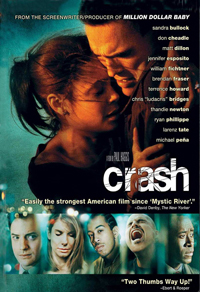 In Paul Haggis’ overwrought and overrated Best Picture nominee Crash, Don Cheadle delivers an opening salvo so artificial and faux-poetic that it even contains the film’s title.
“We’re always behind this metal and glass. It’s the sense of touch,” Cheadle’s self-important Los Angeles police detective says, sitting in a car with his partner/girlfriend, Ria (Jennifer Esposito). “I think we miss that touch so much that we crash into each other just so we can feel something.”
And so begins the most unjustly inflated and grandiose lecture on race relations since a puffed-up Spencer Tracy sermonized Sidney Poitier in the self-righteous and misguided Guess Who’s Coming to Dinner?
This is a re-examination of Crash, a movie I saw last year in the theater, but didn’t review. It’s had so much awards hype since then and gained a huge audience on DVD, that I watched it again last week to make sure I still hated it.

It's all screaming and hugging in 'Crash,' the worst Best Picture winner since 'Driving Miss Daisy.'
And I did — with even more focus.
Don Cheadle is at a murder scene in the City of Angels, on Christmas, the holiest of all Christian days. That is the first of many cruel ironies Paul Haggis uncomfortably hoists upon the audience time and time again. When we discover who the victim is at the end of Crash, it is the last straw in a series of contrived and telegraphed coincidences so brazen that they have passed the realm of preposterousness and entered into self-parody.
Haggis’ approach is simple. Give us a set of expectations (Two young African-Americans, Larenz Tate and Chris ‘Ludacris’ Bridges, argue eloquently about white people judging them as criminals from their skin color) and then upend them. (They proceed to hold up a rich white couple, exemplifying the cliché they’ve just been complaining about.) Put them in a situation where they have to rethink their own behavior, and end with either tragedy or redemption, oppositely tuned to what the audience wants to see happen. Repeat 10 more times.
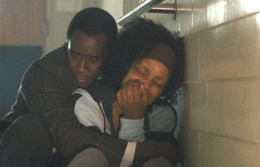 A melting pot of simmering hatred, the film’s inhabitants are both equal opportunity offenders and victims. Almost every character, be they of white, black, Latino, Asian, or Middle Eastern descent, shits on someone else and is, in turn, shat on. No ugly stone is left unturned and rarely is a positive one touched. To make a grim situation truly insulting , their motivations are completely manufactured.
The people in Haggis’ version of L.A. all engage in openly racist behavior, and every crucial decision is informed by racism or because of racist actions against that person. This one single theme, bashed into your skull throughout, is what makes Crash maddening, tiring, and finally, ridiculous.
Unlike Spike Lee’s infinitely wiser and more thought-provoking Do the Right Thing, Crash is a public scolding disguised as entertainment with ‘social value,’ where people don’t behave like actual people, but instead they exist only to prove Haggis’ point. It is a constant source of conflict that everybody is stereotyped by everybody else, but the characters themselves are all stereotypes.
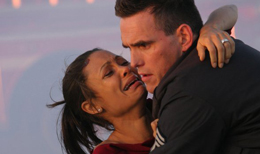 There are better far modern vignette-based movies set in Los Angeles (Short Cuts, Magnolia) that showcase complex characters with recognizably individual traits, and don’t behave like representations of people that are determined by whatever philosophy the screenwriter needs them to represent.
Rarely has a movie been so arrogantly obvious about its intentions, as every character engages in deliberately poor choices, while we sit comfortably, fully aware of the dreadful consequences. Add a nasty tone and a foreboding score, and there are more idiotic yell-at-the-screen moments (“Don’t go in there!”) than a teenage slasher film. This gives us, the audience, an air of superiority.
I am convinced that the movies’ tidiness is the main reason so many moviegoers like Crash. Real people are more mysterious, ambiguous, they don’t follow simple cause/effect patterns, they act inexplicably. It’s not the idea behind Crash that’s so offensive, but it’s the way that that idea presented — as the ultimate argument settler.
Racism and mistrust are gray issues that affect everyone, but by the end, Haggis paints them in efficient black-and-whites. Everyone learns their lesson and we’re all better people now. It’s not that simple. That conceit insults the complexity of the human psyche, comforting us with the pompous notion that we’ve witnessed, once and for all, the solution to a never-ending struggle.

Eric is the Editor-in-Chief of Scene-Stealers.com, a Rotten Tomatoes-approved critic, and contributor for The Pitch. He’s former President of the KCFCC, and drummer for The Dead Girls, Ultimate Fakebook, and Truck Stop Love . He is also the 2013 Air Guitar World Champion Mean Melin, ranked 4th best of all-time. Eric goes to 11. Follow him at:


{ 11 comments }
I feel you on this. Crash is a terrible movie. When I watched it I felt like I was being manipulated into thinking and feeling things. After a while I pictured this movie as a bunch of white movie executives getting together and discussing how much money they could make off a race movie. The movie seemed artificial to the core.
can you write a essay on the movie crash please
the question is “how does ethics play a role in the movie crash”
i need 3 topics for 3 body paragraphs one topic for each body paragraph and i need 3 facts/quotes from the movie for each body paragraph and if anyone does it thank you so much. i need it done by monday october 20th 2008
please can someone write it
thank you
hahahaha “bob billy” are you serious? First, no one is going to do an essay for you. Second, you expected someone to do the essay in one day, since you posted that post on the 19th, you’re an idiot
Man, I had kinda forgotten how much I hated this movie. I remember writing to friends about how much I hated it and how it was sure to win Best Picture. But reading this reminds me of just how horrendous it was. Man, now I´m going to pissed off all day. Why did I click here?
Ha ha ha, Reed! Nice. I had to write about it after all the hype started up again around Oscar time and its nice to refer back to every now and again to get me riled up…
The 2000s were strewn with less than stellar Best Picture winners. It’s a shame there is a winner every year. Gladiator set the bar low, Return of the King didn’t help matters, but No Country for Old Men is the true low point. Here is a movie that has the stupidest of characters, a plot culled from The Terminator, a sherif who doesn’t impact the story, unintentionally humorous violence, all at a snail’s pace.
I agree that the 00s overall were pretty poor for Best Picture winners but not No Country for Old Men that was the best winner of the decade. Gladiator, Chicago, Million Dollar Baby, The Departed and Slumdog Millionaire were all pretty good movies but certainly not the best or even top 5 for me, Crash and a Beautiful Mind were bad films, with Crash being truly terrible. Return of the King is a solid winner and a nice nod to a remarkable series, the hurt locker is a great character drama and suspense film and personally I’m just glad that Avatar didn’t win, No Country is definitely the best best picture winner (even though my favorite movie that year was there will be blood)
Vaughn- I’m with Xavier here too. Here’s my review of “No Country” for argument’s sake, but the first thing I’ll tackle is that the sheriff absolutely impacts the film. He is the voice we identify with, the lens through which we view the cruel fates of the characters. The fact that Josh Brolin’s character was dispatched offscreen only adds to the existential dread of the movie and further drives the point home. Also, much of the violence was absolutely intentional, just like it was in “Fargo.”
Do you live in LA? Or have lived? I’m guessing “no”. Stereotypes are stereo types for a reason. Even Magnolia was full of LA “stereotypes”. I’m sorry you felt manipulated, but that’s how that shit is out here. Magnolia and Crash are pretty accurate accounts of the LA grit and grind.
Can’t say I agree. By far the worst Best Picture in my lifetime was “The English Patient”. What made its victory doubly horrid is that 1996 was one of the best years in recent film history, with the independent films making a huge mark on the box office and flooding mainstream theaters. Instead that monotonous bore was chosen as the best. I didn’t think “Crash” was nearly as bad as you made it out to be. Matt Dillon and Terence Howard are both stellar as usual, and the editing is particularly impressive. The huge flaw in the film is Sandra Bullock, as always, doing her best to single-handedly derail the film with a shrill, high-school level performance in the most unbelievable role in the bunch. “The English Patient”, “Gladiator”, and “Driving Miss Daisy” are all better choices for recent bad Best Picture winners.
As a side note, I’m not so sure that “Do The Right Thing” was a “wiser” film, especially in light of Spike Lee’s recent comments about art influencing life decisions. The only reason the film works is because of Danny Aiello’s portrayal of Sal as a complex, sympathetic character. Aiello and Lee quarrelled through the entire shooting of the film as to the portrayal of Sal – Lee wanted Sal to be an overbearing jerk, while Aiello fought to portray him as is in the film. Think of how the message of the entire film changes of Sal is portrayed as a racist jerk – it then becomes a heavyhanded “black vs. white” moral preaching. The key figure is Sal, and the movie hinges on him. Now consider that just after the Sandy Hook shootings Spike Lee, per his Twitter, told people to “wake up” and that indeed life does imitate art, decrying video games and so forth as promoting violence. So, if that’s true, what exactly what was Lee’s message in “Do The Right Thing”? To riot if you don’t like what’s happening in the world? To incite violence when troublemakers cause problems with business owners? In my eyes, that’s not responsible or “wise”. Just some food for thought.
Comments on this entry are closed.